

Lessons in Growth & Transformation
May 19th, 2026
Starting a Magnolia Tree from a Seed
A Tale as Old as Time
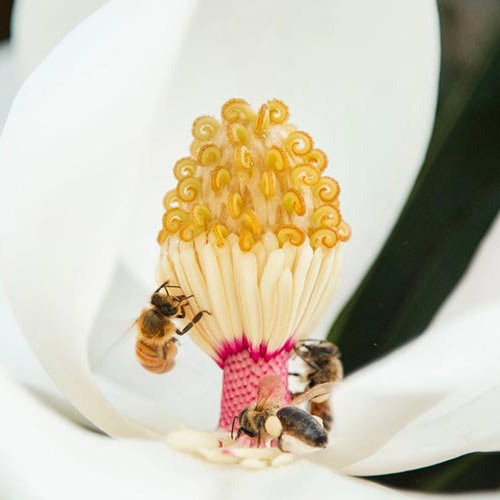
As far back as 95 million years ago, the world has been lucky enough to have magnolia trees. Pollinated by beetles (which predate bees) and evolved to become the standard of both beauty and adaptability, these incredible organisms have been around longer than our brains can even begin to conceptualize.
We as horticulturalists rely on propagation techniques to help us fast-track the growth of new trees, ensuring the integrity and quality of their genetics. Nature, on the other hand, relies on a different technique to continue this species – and many others like it. Seeding is a tale is old as time, and it will never not be a biological marvel.
Today on the blog, we’re digging deep to unearth the secrets of seeds. Who knows, you may even decide to start some yourself!
What’s in a Seed?
That by which we call any other would grow as strong… Oh wait, sorry, wrong class!
Poetically and scientifically speaking, a seed is a microcosm of living potential and life itself. It is both the chicken and the egg, balancing perfectly what has been with what will be. But, you want to know what’s actually in a magnolia seed, so we’ll stop beating around the bush.
The puns just write themselves, honestly.
The Stuff of Life
Let’s go back to high school biology. All living organisms must meet the following criteria to be considered as such:
- Exhibit cellular organization
- Maintain homeostasis
- Process energy
- Grow
- Respond to stimuli
- Reproduce
- Adapt & evolve over time
We’ve already covered adaptation and evolution – Check!
What’s more, we’ve established that a seed is how magnolia trees reproduce – Check again!
That just leaves 5 other requirements to meet no big deal.
Lucky for us, the mere existence and functionality of a seed covers the rest of the criteria.
Respond to Stimuli
Seeds are a lot like that 90s era “Magic Grow” animal toy – the ones that were little capsules containing a sponge. When you drop them in water, the cast dissolves and the sponge inside hydrates and expands into a fun animal shape.
A stimulus is an external condition that triggers change/action in response. For a seed, the first stimulus it ever knows is the presence of water. Temperature and soil can also be considered stimuli, but it is the presence of water that triggers the activation of the genetic material inside.
Process Energy
Once the genetic material inside the seed becomes activated, it needs energy to start building itself into a plant. That’s easy enough; most of what a seed contains is stored energy. It’s just enough to allow the seed to put out its first root, which will allow it to access nutrient energy from the soil.
Exhibit Cellular Organization
That first root is proof of cellular organization: specialized cells have come together to form an operational structure for the first time. With patience, this seed will sprout many more roots, and eventually, stems, leaves, and branches.
Grow
With the right stimuli, a seed’s only job is to grow. This transformative process is why seeds are such symbols of potential and hope. A tree over 50 feet tall that might live over a century could be what grows out of a seed the size of the nail of your little finger. Talk about growth!
Maintain Homeostasis
Homeostasis is, simply put, the ability to have a consistent state of being. It’s an organism’s ability to self-regulate in its environment. This is something magnolias in particular excel at, being one of nature’s earliest flowering trees. These organisms have learned how to roll with all of nature’s punches, evolving mechanisms that allow it to maintain a self-regulated state in the toughest of conditions.
How to Start a Magnolia from a Seed
So, if a seed contains all of this potential and meets all of the criteria for life, how can you (yes, you!) grow a magnolia tree from a seed?
Step 1: Obtain your seeds
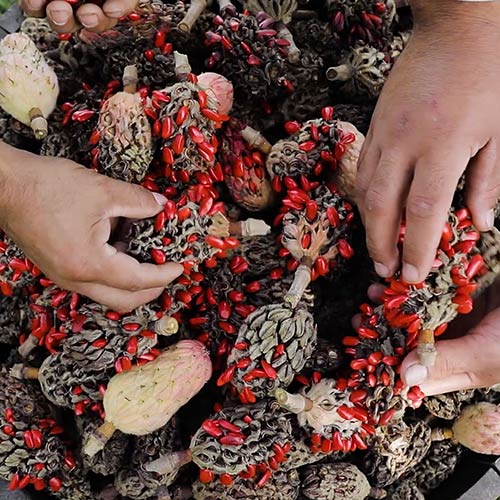
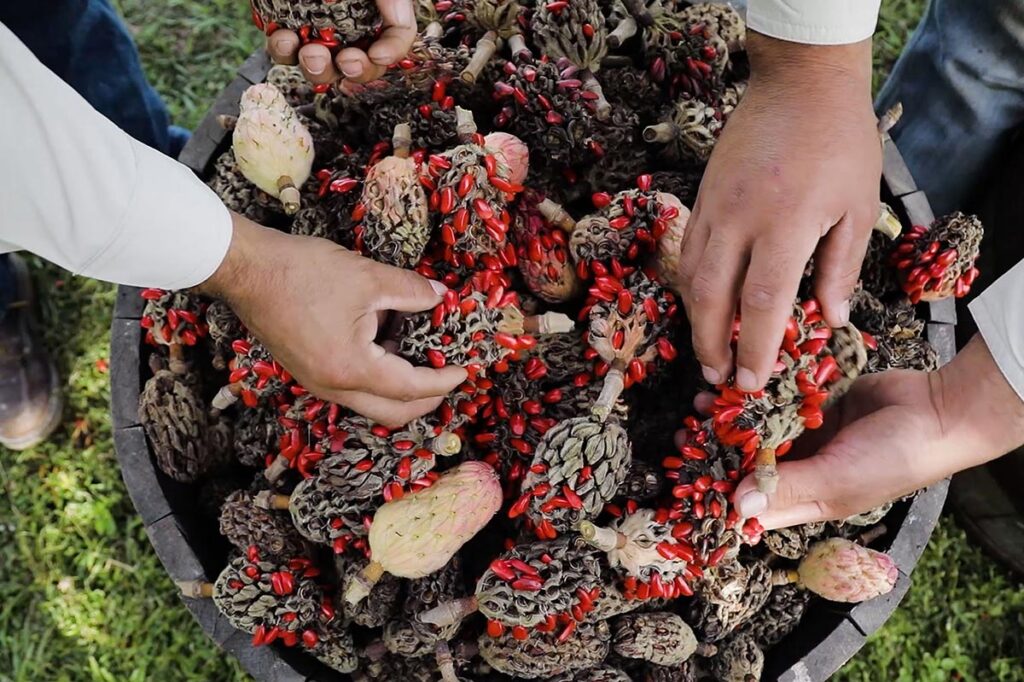
Find your friendly neighborhood magnolia tree, and you’ll want to wait for fall. After the summer has come and passed, you’ll see pods where flowers once bloomed. Wait for these seed pods to dry out on the branch, and they’ll expose their bright red seeds. Grab the pod, and gently pluck out the seeds. You’ll know they’re ready for harvest because they’re barely attached to the pod.
Step 2: De-fruit the seed
The seeds look bright red right now, almost like a berry. This is to attract birds, squirrels, and other animals. When an animal ingests the seed, their stomach strips away the fruit from the seed, which is indigestable. As the animal travels, the seed passes and gets distributed into a new place.
You’ll mimic this process by dropping your collection of seeds into a cup of water, where you’ll let them soak for a day or two. The seeds should appear swollen after that amount of time. The swell indicates the hard shell of the fruit has softened, and you should be able to easily squeeze the seed out. Separate the seeds from the fruit.
*Note: If you want to ensure the health of your seeds, place them back in the cup of water after you’ve stripped the fruit away. Healthy seeds will sink to the bottom, allowing you to separate out the ones that aren’t likely to result in a sprout. This step isn’t 100% necessary, but it can be helpful.
Step 3: Stratification
It sounds complicated, but all stratification does is imitate winter. Grab your handful of seeds and mix them into a bag or tupperware container of sand or soil. Over at The Magnolia Company, our resident plant nerd, Matt, prefers sand.
Saturate the sand and seed mixture with a few ounces of water – just enough to be absorbed into the sand. Make sure it’s all very well combined, and then place your container in the refrigerator (NOT the freezer) for 90-120 days.
Magnolia seeds rely on the presence of water in addition to a cold season to trigger growth.
Step 4: Sow your seeds
In this last step, you’ve waited your 3-4 months for stratification. It’s time to pot!
Gently sift through your seeds. Some might have a single short root coming out; prioritize those.
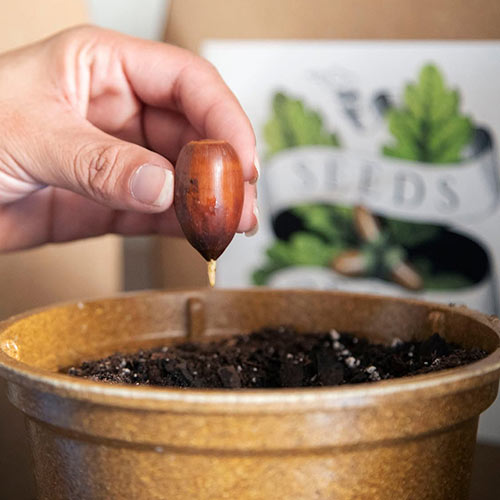
Into a small pot, place your rooted seed root down into the soil, about 1-2 inches deep. Cover the seed with soil, water thoroughly, and wait about 2-3 weeks. You’ll have a spout before you know it!
Remember, these first sprouts and roots are very delicate, so take care to avoid packing down the soil over the top of the seed.
After a month or so of visible growth, you’ll want to upsize the seedling’s pot.
Enjoy your new magnolia tree!